Description
TLDR
- Change Code believes that to achieve the world's sustainability and other impact goals, we must find a way to make purpose profitable. We are pioneering new financial primitives and tokenomics that will see impact emerge as the next asset class to be powered by web3.
- Since Change Code started in March 2024, we have minted and registered nearly 40,000 tons of web3 native carbon credits and begun work tokenizing numerous other economic externalities including solar energy in Nigeria, clean water access in 7 different countries, and ocean life restoration in Belize. In total these projects represent more than $600,000 in public goods and social impact value.
- Having developed our tokenization framework, we're continuing the work toward the monetization of impact. One of our main goals for this round is to demonstrate the use of Change Credits as an alternative means of organizing stakeholders around public goods and to make the funding of those public goods profitable for those backing successful implementations.
Change Code
Change Code has developed a token protocol for impact tokenization and monetization called Change Credits. Change Credits are a new ReFi/DeFi primitive (already in production as web3 native carbon credits) that utilize hypercerts and the Ethereum Attestation Service (EAS) to maximize interoperability with the broader ecosystem.
As a primitive, Change Credits are highly adaptable to many funding and impact verification flows, ranging from retroactive funding and community donations to impact bonds and structured financing for social enterprises.
Impact Bonds
Social and development impact bonds (S/DIBs) are a tool in impact investing designed to transfer risk from the public sector to the private sector and have been used around the world to fund public health, infrastructure, climate, and myriad other innovations. Put simply, impact bonds allow those altruistically funding a public good to be shift the entrepreneurial (implementation) risk to private investors.
To visualize this process, below is how our impact primitive, Change Credits, can be leveraged to form an impact bond.
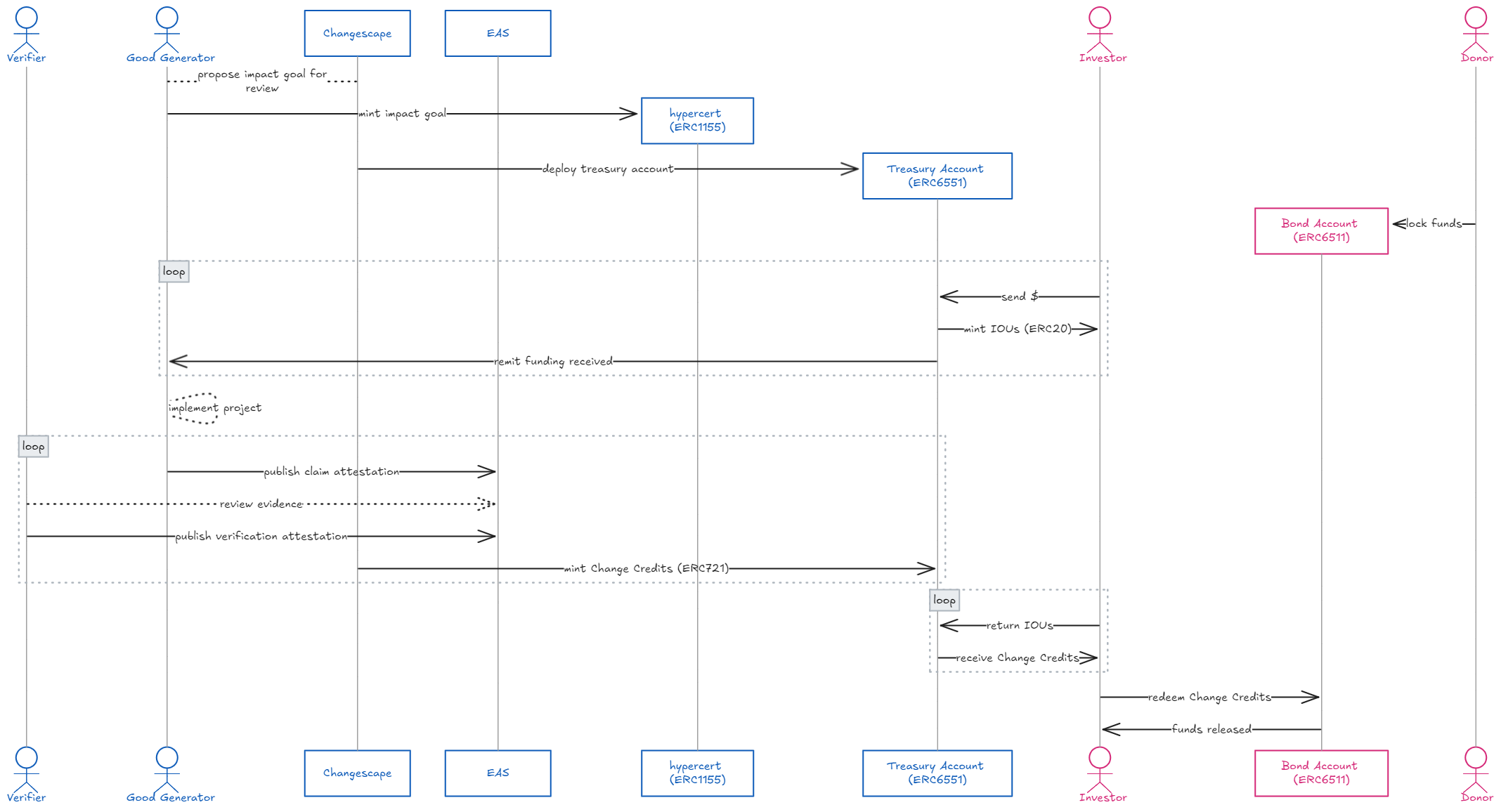
When thinking about funding public goods, we can draw parallels back to the space of impact investment. The desire of a community for a public good to exist can be neatly divided from the evaluation and determination of which teams are most likely to be capable of delivering on that goal.
While retroactive funding is an exciting tool, it does little to address the problems that are too large to be tackled without upfront funding.
Moreover, models where projects are funded in part or even not funded at all in advance (see below) can also be captured seamlessly with the same set of Change Code primitives.
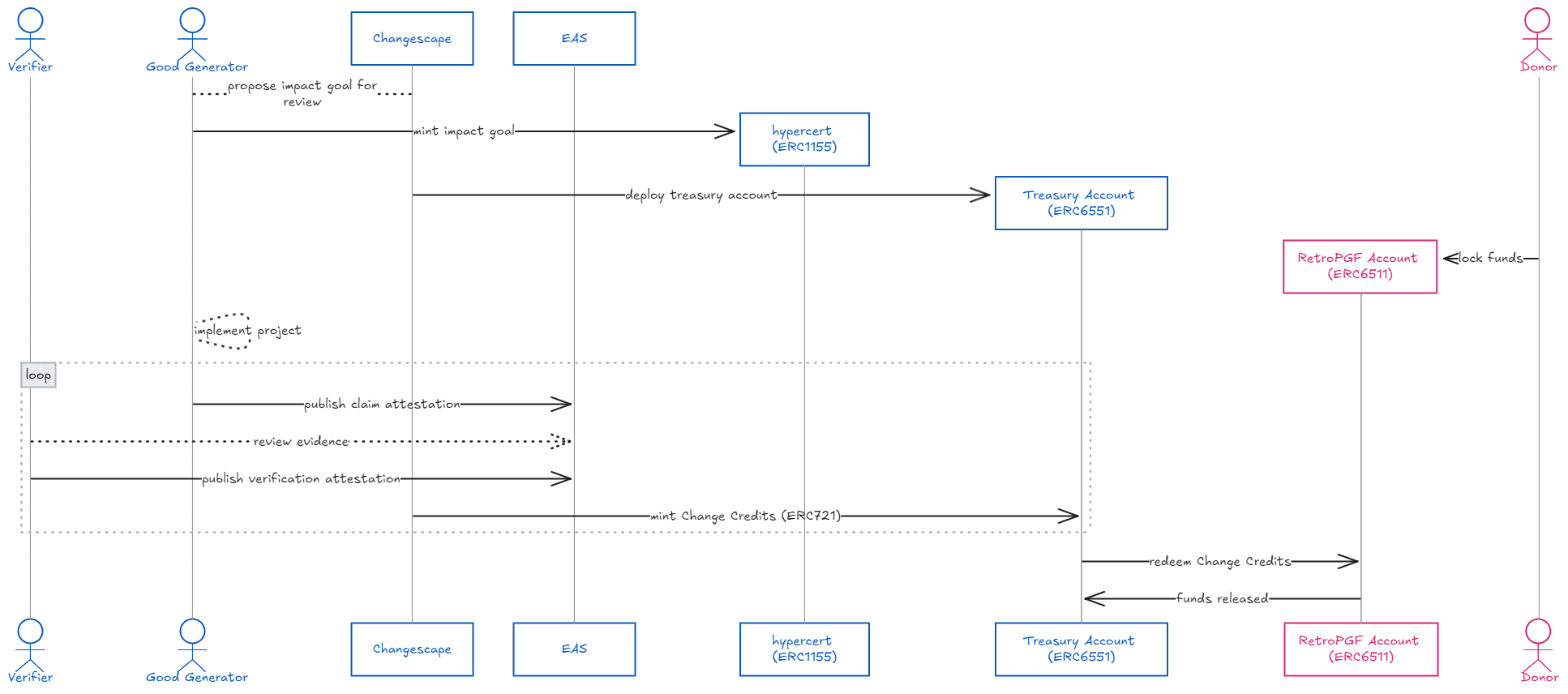
More information on how Change Credits can be leveraged as a new primitive for funding what matters is available in our docs. Also, if you'd like to follow along with our technical development, all of our work is available as open source on our Github.
Contributing to the Superchain
After months of working across different ecosystems in line with requests from particular projects, Change Code is in the process of making our home on the OP Stack and the Superchain. We recently completed a preliminary migration of our contracts and deployment infrastructure to Optimism Sepolia, aligning our own design with the requirements of building on the OP Stack.
Before the end of the quarter, we expect to have all tokens for web3 native carbon credits (38,000 tons and counting) deployed on Celo's Dango L2 testnet so that we are well prepared for the eventual re-launch of Celo as part of the Superchain itself.
The rest of our infrastructure and deployments are being tested and will soon be launched into production directly on Optimism.
In addition to bringing key funding and tokenization infrastructure to the OP Stack and attracting ReFi and social good projects to the Superchain, it is our intention to make the Change Credit protocol another tool available for the Optimism ecosystem to carry out its extensive public goods funding initiatives. While resources to fund public goods may seem vast, they are not endless. Change Code's protocol has the ability to drive funds to the most effective implementors by enabling funds to be committed to public goods in advance and then for investors to competitively determine which projects they believe are most likely to succeed. Our design balances the community's interest in keeping opportunities open to all while channeling treasury or other forms of public funding exclusively toward proven results.