Description
Building on more than 40 years of organizing from the first ever Cascadia Bioregional Congress held in 1986, Regenerate Cascadia is a social movement and capacity-building program developing a vision and framework to administer a bioregional flow fund and financing facility for Cascadia, a bioregion located along the upper Pacific Rim of North America stretching from Southeast Alaska to Northern California, and as far east as the Yellowstone Caldera.
A central goal of Regenerate Cascadia is to grow capacity cohesively across the scales of landscapes, ecoregions, and bioregions—something that currently does not exist locally or globally—as part of a multi-generational strategy for the long-term health of the Cascadia bioregion.

Regenerate Cascadia is developing a critical path toward accelerated landscape-level regeneration across Cascadia that invites people to self-organize into bioregional teams and hubs in order to visualize, connect, and support work in their watersheds. Particularly through participatory activities and capacity-building. We invite these groups to consider:
What does a regenerative future for our bioregion look like? If people were resourced to make this happen, how can this have the most impact and connect regenerators on the ground with funders and the technology we need, as best determined by the people doing the work? How do we build the buy-in and consent of our communities? And lastly, how do we use this “moment” to lead to a regenerative future rather than see it fizzle away?
The mission of Regenerate Cascadia is to regenerate the Cascadia bioregion and create the conditions for a regenerative culture to thrive. As part of this, we educate about bioregionalism, grow the shared context of our place, and give direct funding for the core capacity of teams and projects. We provide much-needed administrative scaffolding as groups are beginning so they can receive and leverage decentralized flow funding and spin out new bioregional initiatives as part of a shared, coherent, multi-generational regeneration strategy.
This first funding round will assist our watershed working groups in locations throughout Cascadia and help us experiment with new forms of shared governance and participatory budgeting processes at the landscape level.
Now, we need your help to connect on-the-ground regenerative organizers, projects, and communities with the power and tools of Web3.

Figure 2: What is a BFF from the BioFi website - https://biofi.earth
Web3 can help break down and move past arbitrary boundaries, map what is important to our communities, identify what needs to be protected, and connect portfolios of projects in the context of an entire landscape in ways we can directly fund and de-risk. We need to create tools for measurement, reporting, and verification (MRV) built through community consent and data sovereignty that help tell the stories of stewardship in ways that catalyze financial flows.
We deeply believe in the founding beliefs of these tools, as outlined by Celo:
Web3 represents an internet where users have more control over their data, identity, and digital assets. This means no central authority controls the network, allowing for more transparency, security, and ownership. Web3 empowers individuals by giving them full control over their digital assets (like cryptocurrencies and NFTs) and how they interact with online services, making it a key shift towards a more open, user-owned internet. In short, Web3 is about returning power to the users—creating a more equitable digital world where your data and assets are yours to manage and control.
Together, we can learn to move money into communities at the scale of a watershed and across nation-state borders–reimagining finance flows so they no longer divide ecosystems and reinforce systematic inequality and racism–but instead create new stories of shared stewardship that truly represent the full spectrum of life present in place.
Learn more about Cascadia BioFi
- Read our Regenerate Cascadia case study in the Bioregional Financing Facilities: Re-Imagining Finance to Regenerate the Planet E-Book
- Learning in parallel: See how we are growing a bioregional funding ecosystem at the first Forum of Bioregional Finance
- Launching the Earth Regeneration Fund: Regenerate Cascadia is one of the first five bioregions
Where does this idea come from?

Figure 3: Our Regenerate Cascadia activation tour. 14 communities in 30 days.
Regenerate Cascadia grew from the 2022 global Regenerative Communities Network summit and was officially formed by Brandon Letsinger and Clare Attwell in April 2023 during the first-ever Salmon Nation Edge Prize, where their vision to activate a bioregional movement in Cascadia won the Edge Prize for Innovation in Systems and Governance.
After months of planning with 100+ local community organizers on both sides of the Canada-US border, they partnered with the Design School for Regenerating Earth to co-facilitate a month-long Bioregional Activation Tour. We traveled to 14 communities around Cascadia during October 2023, hosting presentations that asked, “How do we regenerate the Cascadia bioregion?”. They met with more than 1000 individuals, including Indigenous knowledge keepers, regenerative leaders, groups, community artists, and elders across Oregon, Washington, and British Columbia, through presentations, workshops, site visits, and strategy sessions.

Figure 4: Regenerate Cascadia was joined by Joe Brewer, Penny Heiple and Steven Morris from the Design School from Regenerating Earth. Every stop featured presentations, strategy sessions, field trips, and a showcase of regenerative work.
This was followed by an online summit that brought together 50+ presentations in a ‘Festival of What Works’ and concluded with an Open Space Unconference from November 3-12, 2023, where participants created working groups for Regenerate Cascadia. The vision resonated strongly with many communities across the bioregion, and since then have been working with an organizing team of more than 140 people through Telegram, exploring place-based "hubs," issue-specific "guilds," and supporting a range of amazing and emerging projects, made up of people on-the-ground doing regenerative work in-place.
Learn more about Regenerate Cascadia:
- Watch the presentation: How do we regenerate an entire bioregion?
- Announcing the Winners and Special Honorees for The Edge Prize 2023: Weaving a Bioregional Fabric in the Edges of Salmon Nation
- Fighting climate change by reconnecting to ecosystems in our own backyards - Article in the National Observer
- See the 50+ recordings from the first Cascadia Bioregional Summit hosted last year
Why does it matter?
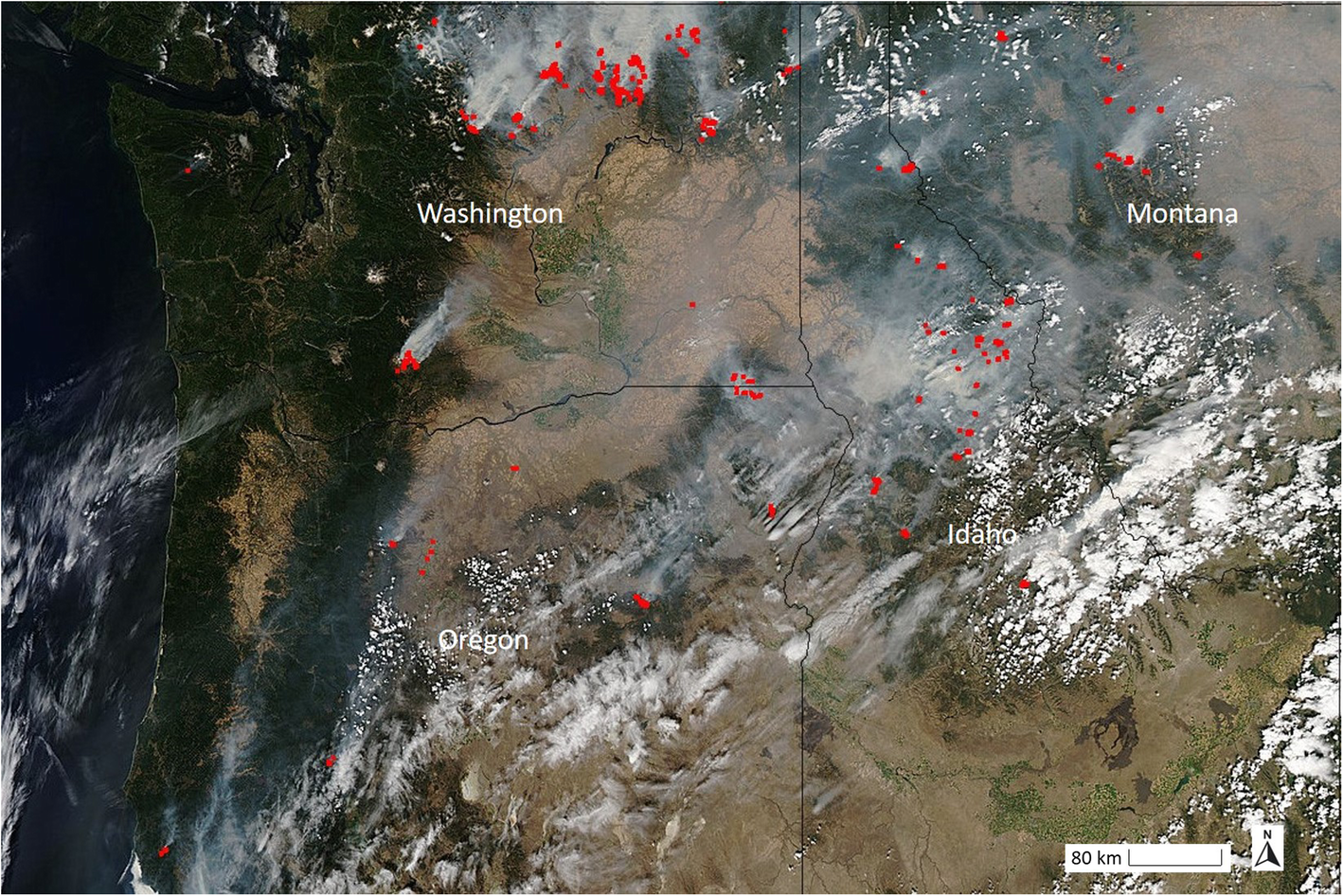
Figure 5: A year of smoke. Satellite image of Cascadian wildfires from 2020.
Nature acts bioregionally. Be it wildfire, drought, flood, energy, food sovereignty, or social and political polarization, to develop adaptive resilience, every community impacted must have substantial influence on decision-making processes, and every community along a watershed must be included. It is the people living here, rather than in power centers thousands of miles away, who are best able to determine the most resilient pathways and actions for themselves and their communities.
Learn more about Cascadia and Bioregional Organizing
- Interview with Brandon Letsinger and David Bollier and the Frontiers of Commoning
- Should We Rearrange the World's Borders According to Nature? Video by Claudia Ayuso, with Brandon Letsinger

Figure 6: Hello from Antartica! Cascadia is more than just a place. It's a movement, a vision and an identity rooted in our love of place.
Thank you everyone for having us here and listening to our story of place. Now, let's make it happen & Viva Cascadia ✊🌲!
If you're unfamiliar with the idea of Cascadia or the Cascadia movement.... below is a bit of context about the bioregion and movement.
What is Cascadia?
Stretching for more than 2500 along the Pacific Rim, the Cascadia bioregion includes British Columbia, Washington, Oregon, Idaho, and parts of Southeast Alaska and Northern California. It is defined through the geology and watersheds of the Fraser, Snake, and Columbia Rivers.

Figure 7: The Cascadia bioregion map by David McCloskey graced the cover of ESRI in 2014 and was featured on the cover of it's annual book. Featuring more than 70 GIS layers, McCloskey published some of the first maps in the 1980's, and coined the term "Cascadia bioregion" as a Seattle University professor in 1981.
We have tremendous opportunities for systemic and strategic impact here and are often considered a "thin green line" between resource extraction to the east and developing markets in Asia.
The Cascadia bioregion is home to more than 16 million people (16,029,520). It has an economy generating more than 1.613147 trillion worth of goods and services annually, making it the world's ninth-largest economy and roughly equivalent to that of Canada or Italy. Its population would be similar in size to Ecuador, Zambia, Cambodia, or the Netherlands. Cascadia contains the largest tracts of untouched old-growth temperate rainforests in the world, including 7 of the top 10 world carbon-absorbing forests, the world's tallest trees, thousands of volcanoes, hot springs, rivers, lakes, inlets, islands, and ocean, and some of the last diminishing, though still impressive wild habitats of salmon, wolves, bear, whale, orca. More than 350 bird and mammal species, 48 reptiles, hundreds of fungi, lichen, and thousands of invertebrates and soil organisms call Cascadia home.
The Cascadia bioregion also transcends the arbitrary border between the United States and Canada, and so must our planning. This is true when looking at the Salish Sea (a shared ecosystem between Seattle and Vancouver, BC, in which eight million people live), the Cascadia subduction zone, which runs the entire length of Cascadia and is where our next megaquake will come from, or the Cascadia megaregion, an urban core between Vancouver, BC and Eugene, OR where 80% of the population live on 17% of the landmass.
The Columbia River watershed alone, the largest in Cascadia, includes parts of six US states and one Canadian province. Its border is traced “not by governments or treaties, but by every drop of liquid that finds a common path to the ocean.”
What is the Cascadia Movement?
Cascadians are brought together by their love of place and desire to protect the things we find special while improving the well-being of everyone and everything living here.
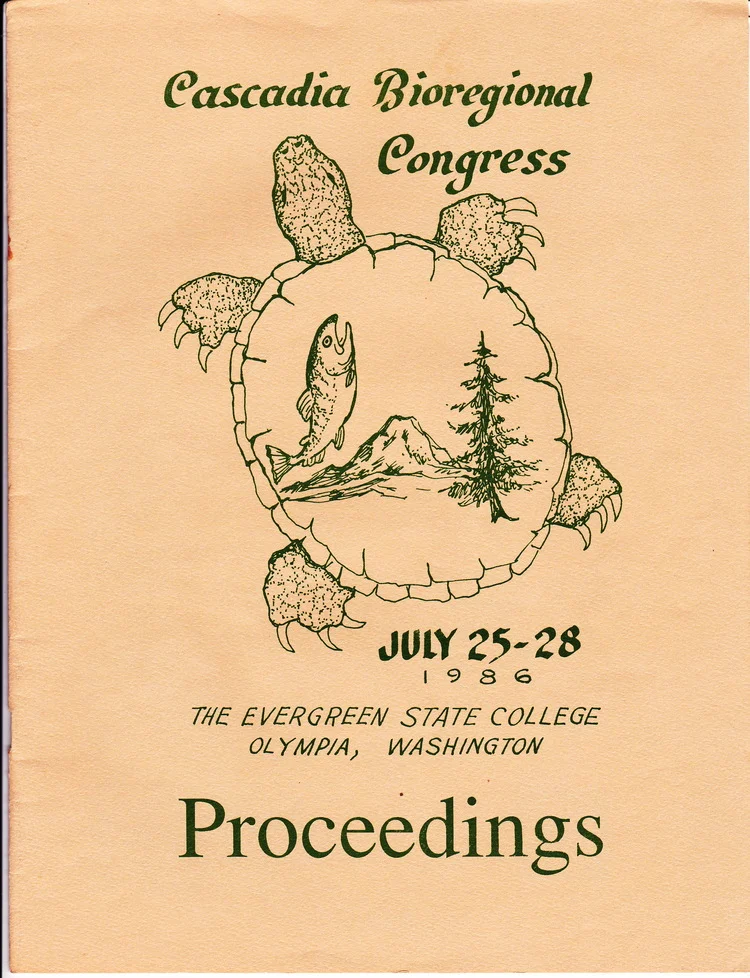
Figure 8: Cascadian bioregional congresses took place every other year from 1986, timed to coincide with the North American bioregional congress, as well as smaller local regional "Ish River" gatherings.
Cascadia was first used as a geologic description in 1981 by Seattle University professor David McCloskey to better describe our growing regional identity. McCloskey describes Cascadia as “a land of falling waters.” He notes the blending of the natural integrity and the sociocultural unity that gives Cascadia its character. It was officially incorporated by policy planners, First Nations, and community organizers at the first Cascadia Bioregional Congress in 1986.
Today, the Cascadia movement includes tens of thousands of individuals, businesses, and community groups throughout the Cascadia bioregion. Cascadia has been featured in many publications, such as Vice Magazine, USA Today, NPR, the CBC, NY Times, CNN, Forbes, Portland Monthly, the Seattle Times, the Wall Street Journal, the Oregonian, and many others.